Selling a catalytic converter in Hawaii
Hawaii moved converters out of the scrap dealer chapter and into the used motor vehicle parts chapter in 2022. A detached converter is a used motor vehicle part, so §§ 289-9 and 289-10 govern it: a written ownership statement plus a receipt or notarized declaration, a tag naming the donor vehicle, payment by check only, and sixty days of possession before the unit can move.
Last checked September 13, 2026; source material current as of November 11, 2025. Laws change. Confirm the current statute and its effective date before relying on this page. This is not legal advice.
Who may sell a detached converter
The two chapters are drawn so they do not overlap. Scrap, in the scrap dealer chapter, means any secondhand or used metal except the used motor vehicle parts provided for in chapter 289 (§ 445-231). A catalytic converter is defined as a device incorporated in a motor vehicle's exhaust system containing a catalyst for converting pollutant gas emissions into less harmful emissions, whether or not it has been removed from the exhaust system (§ 289-1), and a used motor vehicle part is a part that has been the subject of a prior retail sale, individually or attached to a vehicle (§ 289-1). A detached converter therefore sits in chapter 289.
The buyer has to be licensed. It is unlawful for any person or organization not duly licensed under chapter 289 to engage in the business of purchasing or selling used motor vehicle parts or accessories, or in the business of wrecking, salvaging, or dismantling motor vehicles to resell their parts (§ 289-2). A scrap dealer needs a separate license from the treasurer, who may grant it and may revoke it on reasonable cause, and it designates the place where business is carried on and carries a ten dollar annual fee (§ 445-232), and a person licensed under chapter 289 does not pay that fee twice but still has to hold the scrap dealer license and follow §§ 445-232 and 445-233 when acting as a scrap dealer (§ 445-234).
Sellers are not licensed as such, but there is a threshold that turns repeat selling into a business. Making or negotiating a casual or isolated sale is not engaging in business, yet selling or negotiating the purchase of more than three used motor vehicle parts or accessories in any one-year period, other than as an incident to the established business of a licensed seller, is presumptive evidence that the person is engaging in the business and, if unlicensed, is violating § 289-2 (§ 289-1). What every seller does have to produce is paperwork: a signed statement of lawful right to sell, plus either a receipt or a notarized declaration (§ 289-9(a) to (c)).
What the buyer must record
Before buying a converter the licensee obtains a written statement signed by the seller certifying a lawful right to sell and dispose of it, carrying the seller's name, business or residence address, and occupation, a description of every converter including serial numbers and other identifying marks where practical, the amount paid, the date, time, and place of sale, and the license plate number of any vehicle used to bring the unit in (§ 289-9(a)). The seller also provides a copy of a receipt describing with particularity the exact item offered, who issued the receipt, the date of the earlier sale, and the price, if any, the seller paid (§ 289-9(b)).
Where no receipt exists, a notarized declaration takes its place, describing with particularity the exact item, the person who sold or transferred it to the seller, the date of that sale, and the price, if any (§ 289-9(c)). If the seller produces neither, the licensee may not buy the converter, in whole or in part, and has to report the attempted sale to the applicable county police department (§ 289-9(d)). On purchase the licensee takes one or more separate photographs of each individual converter (§ 289-9(e)), and requires the seller to verify identity with a valid photo identification card or driver license issued by a federal or state agency authorized to issue valid identification, then photographs the seller and photocopies that card (§ 289-9(f)).
All of it is kept at the place of business for three years after the purchase: the signed statement, the receipt or notarized declaration, the photographs of the converters, and the seller's photograph and identification copy, all open to examination at any time by the director of finance, the chief of police, the attorney general, the prosecuting attorney, or their designees (§ 289-9(g)). The licensee's general record under § 289-6, kept for three years in the form the director of finance prescribes, separately covers purchases, sales, consignments, and money paid, with names, addresses, and driver license numbers of everyone parts were bought from, names and addresses of buyers, and a description of each part including its identifying numbers (§ 289-6(1) to (4)). The licensee has to attach a tag to it giving the year, make, model, license plate number, and vehicle identification number of the vehicle it came off along with the seller's name, and has to report the purchase to the applicable county police department, where the record is kept in the department's database (§ 289-9(h)).
How you are paid
Payment for a converter is by check, payable to the seller (§ 289-10). At the time of sale the seller presents a valid photo identification card or driver license issued by a federal or state agency authorized to issue valid identification, and the check may be mailed to the address shown on that identification or arranged for the seller to collect personally at the licensee's place of business (§ 289-10). There is no cash option and no card or transfer option in the section.
The metal itself is then held. The licensee has to maintain possession of each purchased converter for sixty days before selling, exchanging, recycling, or otherwise disposing of it (§ 289-9(h)). That is one of the longest statutory holding periods in the country, and it runs alongside the tagging and police reporting duties in the same subsection, so the unit stays identifiable for the whole period.
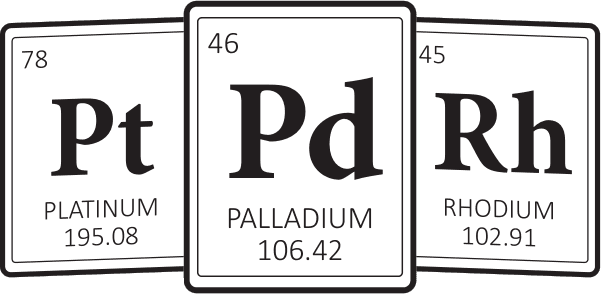
The scrap dealer chapter carries a parallel rule for the metals a converter contains, which matters where a seller is offering catalyst material rather than whole units. If a scrap dealer or recycler buys copper, palladium, platinum, or rhodium, payment is by check payable to the seller against a valid government photo identification, mailed to the address on that identification or collected in person at the place of business (§ 445-233.5(a)). Recycler there means a person engaged in the business of recycling as § 342G-1 defines it (§ 445-233.5(b)).
Penalties
Chapter 289 reserves its heaviest grading for the converter sections. Any person who violates § 289-2, § 289-9, or § 289-10 is guilty of a class C felony (§ 289-8(b)). So dealing in used motor vehicle parts without a license, buying a converter without the statement, receipt or declaration, photographs, tag, police report, and sixty-day hold, and paying for a converter in anything other than a check payable to the seller are all felonies rather than fines.
Everything else in the chapter falls to a general penalty. Whoever violates any provision of the chapter or any lawful rule promulgated by the director of finance under it, where no other penalty is provided by law, is fined not less than twenty-five dollars and not more than five hundred dollars (§ 289-8(a)). The record duties in § 289-6 sit in that band unless the conduct also breaches one of the three felony sections.
On the scrap dealer side the grading turns on the metal. Violating the scrap dealer license section, the statement section, or the check-payment section, or falsifying a required statement, is a misdemeanor, and the same conduct under § 445-233 or § 445-233.5 involving the purchase of palladium, platinum, or rhodium is a class C felony; a § 445-232 license violation stays a misdemeanor (§ 445-235(a)). The court also has to impose at least a one thousand dollar fine for a first offense, three thousand for a second, and five thousand plus a six-month license suspension for a third or later one, with revocation where the third offense falls within five years of two prior offenses (§ 445-235(b)).
What this means when you sell to us
Bring a government photo ID, and for each converter either the receipt for the replacement unit or a notarized declaration covering the same ground: exactly what the unit is, who transferred it to you, when, and what you paid (§ 289-9(b), (c)). Without one of those we cannot buy the unit and have to report the attempted sale (§ 289-9(d)). You sign the ownership statement, we photograph you and each converter, tag every unit with the donor vehicle's details, and report the purchase to the county police (§ 289-9(e), (f), (h)). Payment is by check payable to you, mailed to the address on your identification or held for collection (§ 289-10).