Selling a catalytic converter in Illinois
Illinois puts converters inside the Recyclable Metal Purchase Registration Law and closes the private-seller route. A detached converter may be sold only by someone licensed as an automotive parts recycler or scrap processor, bought only by a licensed recyclable metal dealer at its fixed business address, and recorded with the donor vehicle's identification number and title.
Last checked September 13, 2026; source material current as of November 11, 2025. Laws change. Confirm the current statute and its effective date before relying on this page. This is not legal advice.
Who may sell a detached converter
It is a violation of the Act for any person to possess, purchase, attempt to purchase, sell, or attempt to sell, or for any recyclable metal dealer to purchase or attempt to purchase, any catalytic converter or its contents not attached to a motor vehicle at the time of the transaction unless the seller is licensed as an automotive parts recycler or scrap processor (815 ILCS 325/4.1(a)(4)). The same subsection also closes off materials clearly marked as belonging to a business or to someone other than the seller, government, utility, and railroad property, and cemetery plaques or ornaments (815 ILCS 325/4.1(a)(1) to (3)).
The buying side is fixed too. It is unlawful for any person to purchase or otherwise acquire a used, detached converter or any nonferrous part of one unless the person is a licensed recyclable metal dealer, the sale or purchase occurs at the fixed business address of a licensed recyclable metal dealer that is a party to the transaction, and the purchaser has maintained the information § 3 of the Act requires (815 ILCS 325/4.4(a)). So both ends of the transaction are licensed, and it has to happen at a fixed site. One caution about the word licensed: § 6, the Act's own registration provision, was repealed by Public Act 98-692 effective July 1, 2014, so the Act conditions converter buying on being a licensed recyclable metal dealer without itself saying how that license is issued (815 ILCS 325/4.4(a)(1), (2)).
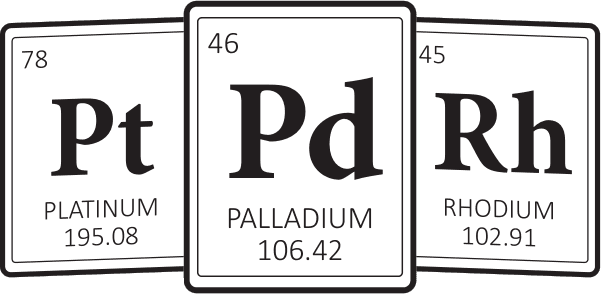
The definitions explain why converters are covered. A catalytic converter is a post-combustion device that oxidizes hydrocarbons and carbon monoxide gases or reduces oxides of nitrogen and is designed or intended for use as part of an emission control system, and includes nonferrous parts such as rhodium, platinum, and palladium; a detached catalytic converter is one previously installed on a motor vehicle and since removed (815 ILCS 325/2). Recyclable metal means copper, brass, or aluminum, or any combination, or any catalytic converter or its contents bought by a recyclable metal dealer, irrespective of form or quantity (815 ILCS 325/2). A recyclable metal dealer is a business buying and reselling recyclable metal at a permanent place of business or itinerantly, but expressly not automotive parts recyclers, scrap processors, repairers, and rebuilders licensed under § 5-301 of the Illinois Vehicle Code (815 ILCS 325/2).
What the buyer must record
For each purchase of recyclable metal, a converter or its contents, or recyclable metal containing copper, the dealer enters into an electronic record-keeping system the dealer's own name and address, the date and place of the purchase, and the name, address, and a copy of the seller's license as an automotive parts recycler or scrap processor issued by the Secretary of State, verified against a valid driver license or other government photo identification, with a photocopy or electronic scan made of both (815 ILCS 325/3(1) to (3)). Where the person delivering the metal has no valid driver license or other government photo identification, the dealer may not complete the transaction at all (815 ILCS 325/3(3)).
The record then covers the load. It carries the plate number and state of issuance of the vehicle or conveyance the metal arrived on, and a description of the metal including its weight and whether it consists of bars, cable, ingots, rods, tubing, wire, wire scraps, clamps, connectors, other appurtenances, or a combination (815 ILCS 325/3(4), (5)). For a converter transaction the description also carries the vehicle identification number of the vehicle the converter was removed from and any numbers, bar codes, stickers, or other unique markings on the unit (815 ILCS 325/3(5)). Photographs or video, or both, are taken of the seller and of the materials as presented on the scale (815 ILCS 325/3(6)).
Two documents complete the entry. The seller signs and dates a declaration reading: "I, the undersigned, affirm under penalty of law that the property that is subject to this transaction is not to the best of my knowledge stolen property." (815 ILCS 325/3(7)). And for a converter transaction the dealer takes a copy of the certificate of title or uniform invoice showing the seller's ownership in the vehicle (815 ILCS 325/3(8)). Retention is tiered and the paperwork extends past the transaction. Purchase records are kept for three years, photographs for three months, and video recordings for one month, and the electronic record-keeping system is available for inspection at any time by any law enforcement official or by representatives of common carriers and of firms engaged in generating, transmitting, or distributing electricity or in telephone, telegraph, or other communications (815 ILCS 325/3). A dealer also has to complete and file a Form 1099-MISC on the seller's behalf unless the seller holds a current automotive parts recycler or scrap processor license from the Secretary of State (815 ILCS 325/3). Where a dealer suspects property in its possession is lost or stolen, it immediately notifies the local law enforcement agency with jurisdiction and provides the seller's information (815 ILCS 325/4.6).
How you are paid
Illinois sets a cash ceiling rather than a cash ban. A recyclable metal dealer may not pay cash for any catalytic converter or its contents having a value of one hundred dollars or more (815 ILCS 325/4.4(b)). Since a single converter is normally worth well over that, the practical result is that converters are paid by a traceable method, though the Act does not spell out which one for converters in the way it does for other materials.
The parallel sections show the pattern Illinois uses. For an air conditioner evaporator coil or condenser worth one hundred dollars or more, and for copper including copper tubing or wiring at that value, payment has to be by check or money order, the payee has to be the same person as the seller who conducted the transaction, and where the seller is a business the check or money order is made payable to the company rather than to any individual employee or agent (815 ILCS 325/4.2, 4.3). A 2027 amendment extends the copper section to telecommunications wire on the same terms (815 ILCS 325/4.3), and the same act adds a telecommunications wire restriction as § 4.1(a)(5) and widens the § 2 definition of recyclable metal to cover telecommunications wire, all effective January 1, 2027 (815 ILCS 325/2, 325/4.1).
Nothing in the Act imposes a waiting period on the converter or on the money. There is no statutory hold on the metal and no delay before a seller can collect, so the timing is set by the dealer. The record-keeping obligation is what runs on: purchase records for three years, photographs for three months, and video for one month (815 ILCS 325/3).
Penalties
The Act has a single, blunt penalty provision. Any recyclable metal dealer or other person who knowingly fails to comply with the Act is guilty of a Class A misdemeanor for a first offense and a Class 4 felony for a second or subsequent offense, each day of a dealer's non-compliance is a separate offense, and any metal obtained other than in accordance with the Act is subject to immediate forfeiture (815 ILCS 325/8). Because § 4.1 makes the seller's conduct a violation of the Act in its own right, a seller who offers a detached converter without an automotive parts recycler or scrap processor license is exposed to the same grading as the dealer.
Enforcement also runs through the civil courts. The Illinois Attorney General, or the State's Attorney for the county where the dealer is located, may bring an action in the circuit court of that county to prevent the unlawful operation of a recyclable metal dealer, to restrain, correct, or abate a violation of the Act, or to prevent any illegal act or conduct by the dealer (815 ILCS 325/9).
Two carve-outs are worth knowing because they change which rules apply. The record, HVAC payment, and copper payment sections do not apply to electrical contractors, to state or federal agencies, to units of local government or their agents that have contracted with the dealer to dispose of metal street signs, to common carriers, to firms regularly engaged in manufacturing or in selling recyclable metal wholesale or retail, to demolition firms, to dealer-to-dealer purchases, or to purchases from electric, telephone, telegraph, and other communications firms, provided the seller supplies a bill of sale or other written evidence of title at the time of purchase (815 ILCS 325/5). The Act also does not apply in a municipality whose own ordinance substantially complies with its substantive provisions and holds a certificate of exemption from the state police, and it does not apply at all in municipalities of one million or more (815 ILCS 325/7).
What this means when you sell to us
Illinois only allows converter sales by holders of a Secretary of State automotive parts recycler or scrap processor license, so bring that license along with a government photo ID; we copy both, and without photo identification we cannot complete the transaction (815 ILCS 325/4.1(a)(4), 325/3(3)). Bring the vehicle identification number for each unit and a copy of the certificate of title or uniform invoice showing your ownership in that vehicle (815 ILCS 325/3(5), (8)). You sign the not-stolen declaration, and we photograph you and the units on the scale (815 ILCS 325/3(6), (7)). Cash is not available for a converter worth one hundred dollars or more (815 ILCS 325/4.4(b)).